

Every business owner dreams of growth. More customers, higher revenue, and a stronger market presence are goals that drive entrepreneurs every day. However, many founders assume that scaling a business always requires hiring more employees, investing in larger office spaces, or significantly increasing operational expenses. In reality, sustainable growth is not about spending more—it’s about using your existing resources more efficiently.
Successful businesses understand that scaling is achieved by improving productivity, streamlining operations, and creating systems that allow the business to grow without a proportional increase in costs. The focus should be on working smarter, not simply working harder. Here are practical strategies that can help you scale your business while keeping costs under control.
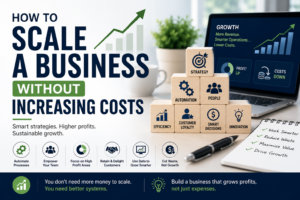
Build Efficient Business Systems
A business that depends entirely on its founder will eventually reach a growth limit. Creating repeatable systems allows daily operations to run smoothly without constant supervision. Standard Operating Procedures (SOPs), documented workflows, and clearly defined responsibilities reduce errors, improve consistency, and save valuable time.
When every team member follows the same process, productivity increases and the business becomes easier to manage and expand.
Automate Repetitive Tasks
Many routine business activities consume valuable time that could be better spent on strategic growth. Automating repetitive tasks such as invoice generation, customer follow-ups, email marketing, appointment scheduling, inventory updates, and payroll processing improves efficiency while reducing manual errors.
Automation allows employees to focus on high-value activities that contribute directly to customer satisfaction and business growth.
Improve Employee Productivity
Hiring additional staff is not always the solution to increased workload. Instead, focus on improving the productivity of your existing team. Provide regular training, set clear performance expectations, eliminate unnecessary meetings, and equip employees with the right tools to perform their work efficiently.
A motivated and skilled workforce often delivers better results than simply increasing headcount.
Retain Existing Customers
Acquiring new customers typically costs much more than retaining current ones. Businesses that focus on customer satisfaction, personalized service, and strong after-sales support often generate repeat purchases and valuable referrals.
Loyal customers not only increase revenue but also reduce marketing costs because they already trust your business and are more likely to recommend it to others.
Focus on High-Profit Products and Services
Not every product or service contributes equally to your profits. Regularly review your sales and financial reports to identify your highest-margin offerings. Allocate more marketing resources toward products or services that generate greater profitability while evaluating whether low-performing offerings should be improved or discontinued.
Selling more of your most profitable products increases revenue without significantly increasing operational costs.
Use Data to Make Better Decisions
Business decisions should be supported by reliable data rather than assumptions. Monitor key performance indicators such as customer acquisition cost, conversion rates, profit margins, employee productivity, and customer retention. These insights help identify inefficiencies and reveal opportunities for improvement.
Businesses that regularly analyse their performance can respond more quickly to changing market conditions and make smarter investment decisions.
Strengthen Your Digital Presence
A strong online presence enables businesses to reach more customers without opening additional physical locations. Investing in search engine optimization (SEO), content marketing, social media, email campaigns, and a user-friendly website helps generate qualified leads at a lower long-term cost compared to traditional advertising.
Digital channels also allow businesses to measure campaign performance and continuously optimize marketing efforts.
Outsource Non-Core Activities
Not every business function needs to be managed internally. Outsourcing activities such as accounting, payroll, IT support, digital marketing, graphic design, or legal compliance allows businesses to access professional expertise without the expense of hiring full-time employees.
This approach reduces overhead costs while enabling internal teams to concentrate on activities that directly contribute to business growth.
Reduce Operational Waste
Many businesses lose money through inefficient processes, unnecessary inventory, duplicate work, and poor resource utilization. Conduct regular operational reviews to identify activities that add little value to customers or the business.
Small efficiency improvements, when implemented consistently, can generate significant cost savings over time.
Build Strong Customer Relationships
Customers who trust your business are more likely to make repeat purchases, purchase additional products, and recommend your services to others. Providing excellent customer support, responding promptly to concerns, and maintaining consistent communication strengthens long-term relationships.
Customer loyalty creates sustainable revenue growth without continuously increasing customer acquisition costs.
Monitor Cash Flow Carefully
Growth requires healthy cash flow. Even profitable businesses can experience financial difficulties if cash inflows and outflows are not managed effectively. Review cash flow statements regularly, monitor outstanding payments, control unnecessary expenses, and maintain adequate working capital.
Strong financial discipline provides the flexibility needed to invest in future growth opportunities without relying heavily on external funding.
Encourage Continuous Improvement
Scaling is an ongoing process rather than a one-time achievement. Encourage employees to identify opportunities for improvement, simplify workflows, and eliminate inefficiencies. Small operational improvements made consistently across different areas of the business often produce substantial long-term results.
Businesses that embrace continuous improvement remain competitive and adapt more effectively to changing customer expectations.
Scaling a business does not necessarily require a significant increase in expenses. The most successful companies grow by improving efficiency, leveraging technology, strengthening customer relationships, and making data-driven decisions. By focusing on systems, automation, productivity, and operational excellence, founders can increase revenue while maintaining healthy profit margins.
Growth should never be measured solely by the size of your workforce or office space. True business growth occurs when your organization can serve more customers, generate higher profits, and deliver consistent value without proportionally increasing costs.
If your goal is to build a business that is profitable, sustainable, and scalable, start by optimizing what you already have. Small improvements implemented today can create extraordinary results in the future.