

The food processing industry is one of the fastest-growing manufacturing sectors in Tamil Nadu. Whether you’re planning to establish a spice manufacturing unit, flour mill, milk processing plant, bakery, snacks manufacturing unit, pickle factory, edible oil unit, or packaged food manufacturing facility, obtaining a Factory License is a crucial legal requirement before commencing production.
In addition to a Factory License, food processing businesses must comply with several other statutory approvals, including an FSSAI License, Pollution Control Board Consent, Fire Safety approvals (where applicable), and labour law compliances. This guide explains everything you need to know about obtaining a Factory License for a food processing unit in Tamil Nadu.
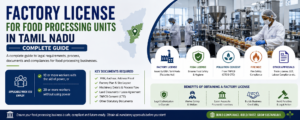
What is a Factory License?
A Factory License is a statutory approval issued by the Directorate of Industrial Safety and Health (DISH), Government of Tamil Nadu, under the Factories Act and applicable state rules. It ensures that manufacturing units maintain adequate standards for worker safety, health, welfare, machinery, and workplace conditions. Factories meeting the prescribed threshold of workers and manufacturing activities are required to obtain this licence before commencing operations.
Is a Factory License Mandatory for Food Processing Units?
Yes, a Factory License is mandatory if your food processing unit falls within the definition of a factory under applicable law. Generally, a licence is required when a manufacturing unit employs:
- 10 or more workers with the aid of power, or
- 20 or more workers without using power.
Types of Food Processing Units Requiring Factory License
A Factory License may be required for various food manufacturing businesses, including:
- Spice powder manufacturing
- Masala manufacturing
- Rice mills
- Flour mills
- Milk processing units
- Dairy product manufacturing
- Bakery units
- Biscuit manufacturing
- Pickle manufacturing
- Ready-to-eat food processing
- Snacks manufacturing
- Flour mixing units
- Oil extraction units
- Beverage manufacturing
- Ice cream manufacturing
- Packaged drinking water plants
- Pulses processing
- Dry fruit processing
- Fruit and vegetable processing
- Food packaging and repacking units
Factory License vs FSSAI License
Many entrepreneurs assume that obtaining an FSSAI License is sufficient to operate a food manufacturing business. However, these licenses serve different purposes.

Every food business operator must obtain the appropriate FSSAI registration or licence depending on turnover, production capacity and business type
Documents Required for Factory License in Tamil Nadu
The documents commonly required include:
- PAN of the business
- Aadhaar and address proof of occupier/director
- Certificate of Incorporation or Partnership Deed
- Memorandum and Articles of Association (for companies)
- Factory building plan approved by competent authority
- Site layout plan
- Machinery list with horsepower details
- Manufacturing process flow chart
- Land ownership documents or registered lease agreement
- Electricity connection details
- Fire NOC (where applicable)
- Pollution Control Board Consent (Consent to Establish)
- Details of workers
- Appointment letter of Factory Manager (if applicable)
Additional documents may be required depending on the nature of manufacturing activities
Additional Licenses Required for Food Processing Units
Apart from the Factory License, a food processing unit may also require:
- FSSAI License
- Tamil Nadu Pollution Control Board Consent to Establish (CTE)
- Consent to Operate (CTO)
- Fire Safety NOC (where applicable)
- Trade License from the local authority (if applicable)
- GST Registration
- Professional Tax Registration
- EPF Registration
- ESI Registration
- Boiler Registration (where applicable)
- Legal Metrology Registration (for packaged commodities)
- BIS Certification (where applicable)
The exact approvals depend on the scale and nature of operations.
Factory License Application Process
The typical process includes:
- Site selection and feasibility verification.
- Preparation of factory layout and building plans.
- Collection of statutory documents.
- Submission of application to the competent authority.
- Scrutiny of documents.
- Inspection of the factory premises.
- Rectification of deficiencies, if any.
- Payment of prescribed government fees.
- Grant of Factory License.
FSSAI Requirements for Food Processing Units
Every food processing business must also obtain the appropriate FSSAI Registration, State Licence, or Central Licence depending on turnover, production capacity and business category. Manufacturing units are required to submit documents such as a layout plan, machinery details, food categories, identity proof, and Form B when applying for a licence.
Common Reasons for Factory License Rejection
Applications may be delayed or rejected due to:
- Incorrect factory layout
- Incomplete documentation
- Absence of Pollution Control approval
- Inadequate worker safety measures
- Improper machine installation
- Fire safety deficiencies
- Structural non-compliance
- Incorrect worker details
- Failure to meet statutory requirements
Careful planning before filing can significantly reduce approval delays.
Benefits of Obtaining a Factory License
A valid Factory License offers several advantages:
- Legal authorization to operate a manufacturing facility
- Improved workplace safety and employee welfare
- Easier access to bank finance and government incentives
- Better compliance with labour and industrial regulations
- Increased business credibility with customers and suppliers
- Reduced risk of penalties and legal action
Penalties for Operating Without a Factory License
Operating a manufacturing unit without the required Factory License may lead to inspections, notices, penalties, prosecution, or even closure of operations under applicable laws. It is therefore advisable to secure all mandatory approvals before commencing commercial production.
Frequently Asked Questions
Is a Factory License mandatory for a small food manufacturing unit? It depends on the number of workers employed, whether power is used, and whether the unit falls within the legal definition of a factory.
Can I start production with only an FSSAI License? No. If your establishment qualifies as a factory, you must obtain the required Factory License in addition to the appropriate FSSAI approval.
How long does the Factory License process take? The timeline varies based on document readiness, inspections, and compliance with statutory requirements.
Can home-based food businesses obtain a Factory License? Most home-based food businesses do not qualify as factories. They generally require FSSAI registration or licensing and other local approvals depending on their scale of operations.
Obtaining a Factory License is a critical step in establishing a compliant food processing business in Tamil Nadu. Whether you manufacture spices, dairy products, packaged foods, bakery items, beverages, or processed agricultural products, ensuring compliance with factory safety regulations and food safety standards helps protect your business, employees, and customers.
Before commencing production, verify all applicable statutory approvals—including Factory License, FSSAI Licence, Pollution Control Board consent, and any sector-specific permissions—to ensure smooth and legally compliant operations