

Businesses operating across multiple States or Union Territories (UTs) in India may need to obtain separate GST registrations for each State or UT where they have a business presence. To simplify the initial registration process, the GST system provides a Master Temporary Reference Number (Master TRN) mechanism for applicants registering in multiple States or UTs.
A key feature of this process is:
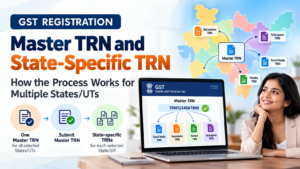
One Master TRN will be generated for all the States/UTs selected. Upon submitting the Master TRN, State-specific TRNs will be generated for each State/UT selected.
But what does this actually mean for a business? Let us understand the process step by step.
What is a TRN?
A Temporary Reference Number (TRN) is a temporary number generated by the GST portal when an applicant starts the GST registration process.
It allows the applicant to save and continue a GST registration application before completing the final submission.
For example, if a business starts a GST registration application and provides its initial details, the GST portal generates a TRN. The applicant can use this TRN along with the relevant credentials to access the saved application and continue the registration process.
What is a Master TRN?
A Master TRN is generated when a taxpayer selects multiple States or Union Territories for GST registration through the applicable registration process.
Instead of beginning completely separate initial applications for every State, the applicant can select the required States/UTs under the same registration exercise.
The system generates one Master TRN for the selected States/UTs.
Example
Suppose ABC Private Limited wants GST registration in:
-
Tamil Nadu
-
Karnataka
-
Kerala
-
Telangana
The applicant selects all four States during the applicable GST registration process.
The GST system generates:
One Master TRN
This Master TRN is associated with the selected States/UTs.
What Happens After the Master TRN Is Submitted?
The Master TRN is used to proceed with the registration process for the selected States/UTs.
Once the Master TRN is submitted, the GST system generates State-specific TRNs for each selected State or Union Territory.
For the example above, the system would generate separate TRNs corresponding to:
State/UTTRNTamil NaduState-specific TRNKarnatakaState-specific TRNKeralaState-specific TRNTelanganaState-specific TRN
The important point is that the Master TRN does not become the GSTIN. It is part of the registration workflow. Each State/UT registration continues as a separate GST registration application.
Master TRN vs State-Specific TRN
It is useful to understand the difference between these two types of TRNs.
ParticularMaster TRNState-Specific TRNPurposeInitiates/organises registration for multiple States/UTsUsed for the individual State/UT registrationNumber generatedOneOne for each selected State/UTCoverageMultiple States/UTs selected by the applicantIndividual State/UTGSTINDoes not represent a GSTINLeads to the individual GST registration processApplicationCommon initial registration workflowSeparate State/UT application
Step-by-Step Master TRN Process
Step 1: Start GST Registration
The applicant begins the GST registration process through the GST portal and provides the required initial information.
The applicant must ensure that the information entered is accurate because it forms the basis for the registration application.
Step 2: Select Multiple States or UTs
Where applicable, the applicant can identify the States or Union Territories in which GST registration is required.
For example, a company operating offices in Tamil Nadu, Karnataka and Kerala may select all three States.
Step 3: Master TRN Generation
After the initial registration details are submitted, the GST system generates a Master TRN covering the selected States/UTs.
The applicant should keep this TRN safely for further processing.
Step 4: Submit the Master TRN
The applicant proceeds with the Master TRN and completes the required information and submission process.
This allows the GST system to create the corresponding State-level registration references.
Step 5: State-Specific TRNs Are Generated
After submission, the system generates a separate State-specific TRN for each selected State/UT.
These State-specific TRNs allow the registration applications to be processed individually for the respective jurisdictions.
Step 6: Complete State-Level Applications
The applicant must provide the relevant details and documents required for each State/UT registration.
This may include information relating to:
-
Principal place of business
-
Additional places of business
-
Nature of business
-
Promoters/partners/directors
-
Authorized signatory
-
Bank account details, wherever applicable
-
Business activity
-
Supporting documents
-
State-specific information, wherever required
Step 7: Application Processing
Each State/UT registration application is processed separately by the GST authorities as applicable.
Therefore, obtaining a Master TRN does not mean that the business automatically receives GST registration in every selected State.
Does One Master TRN Mean One GSTIN?
No.
This is one of the most important points to understand.
A Master TRN is a temporary registration reference used in the application process. It is not a GSTIN.
A business having registrations in multiple States generally receives separate GSTINs for the respective State registrations.
Example
If ABC Private Limited has valid GST registrations in:
-
Tamil Nadu
-
Karnataka
-
Kerala
the company would have separate GSTINs for those registrations.
The Master TRN simply helps initiate and organise the multi-State registration process.
Why Is the Master TRN Useful?
The Master TRN approach can make the initial registration process more organised for businesses that need registrations across multiple jurisdictions.
1. Simplifies Initial Registration
Instead of treating every State as an entirely unrelated starting point, the applicant can initiate the multi-State registration process through the common workflow.
2. Helps Organise Multiple Applications
Businesses operating in several States can keep track of the State-specific applications generated from the common registration process.
3. Reduces Repetition at the Initial Stage
Common information can be captured during the initial registration process, reducing unnecessary repetition in the early stage of the workflow.
4. Supports Multi-State Businesses
Companies with branches, offices, warehouses or other business locations in different States can benefit from a structured registration process.
Important: State-Wise GST Registration Still Matters
The Master TRN should not be confused with the concept of a single GST registration covering all of India.
GST registration is generally administered on a State/UT basis. A business may therefore have multiple GST registrations depending on its business structure, locations and applicable GST provisions.
For example:
ABC Private Limited
↓ Master TRN
↓
Tamil Nadu → State-specific TRN → GST Registration/GSTIN
Karnataka → State-specific TRN → GST Registration/GSTIN
Kerala → State-specific TRN → GST Registration/GSTIN
This means the Master TRN acts as an entry point for the multi-State registration workflow, while the State-specific TRNs correspond to the individual State/UT applications.
What Businesses Should Keep Ready
Businesses planning registrations in multiple States should generally keep their registration information and supporting documents organised before beginning the process.
Commonly required information may include:
-
PAN details
-
Mobile number and email ID
-
Business constitution documents
-
Promoter/director/partner details
-
Authorized signatory details
-
Principal place of business proof
-
Additional place of business details
-
Rental/lease documents, where applicable
-
Electricity bill or other address proof
-
Bank account information
-
Nature of business activities
-
Details of goods/services supplied
The exact requirements can vary depending on the constitution and circumstances of the business.
Common Mistakes to Avoid
Mistake 1: Assuming the Master TRN Is the GSTIN
A TRN is only a temporary application reference. It should not be treated as the final GST registration number.
Mistake 2: Assuming One GSTIN Covers All States
A business with GST registrations in multiple States generally has separate GSTINs for those registrations.
Mistake 3: Ignoring State-Specific Applications
Once State-specific TRNs are generated, the applicant must complete the relevant State/UT registration requirements.
Mistake 4: Entering Incorrect Business Address Details
The principal place of business and additional business locations should be entered carefully and supported by appropriate documents.
Mistake 5: Losing TRN Details
Applicants should maintain proper records of the Master TRN and subsequent State-specific TRNs so that the applications can be tracked and continued.
Simple Example
Consider a company called XYZ Technologies Private Limited.
The company has business locations in:
Tamil Nadu + Karnataka + Andhra Pradesh
The registration workflow can be understood as:
Step 1: Select the three States/UTs.
Step 2: A Master TRN is generated.
Step 3: Submit the Master TRN.
Step 4: State-specific TRNs are generated.
Step 5: Complete the individual State/UT applications.
Step 6: GST authorities process the respective applications.
Step 7: Upon approval, the applicable GST registration/GSTIN is issued for each State/UT.
Therefore:
1 Master TRN → Multiple State-Specific TRNs → Individual State GST Registrations
Frequently Asked Questions
Is a Master TRN the same as a GSTIN?
No. A Master TRN is a temporary reference associated with the GST registration application process. A GSTIN is the registration number issued after GST registration is granted.
How many State-specific TRNs can be generated?
The number depends on the number of States/UTs selected in the registration process.
Can a company have multiple GSTINs?
Yes. A business may have separate GST registrations and GSTINs for different States/UTs, subject to the applicable GST provisions.
Do State-specific TRNs mean GST registration is approved?
No. A TRN indicates an application/reference in the registration process. GST registration is granted only after the application is processed and approved by the appropriate authority.
Why is a Master TRN generated?
The Master TRN provides a common reference for the initial multi-State/UT registration process, after which State-specific TRNs can be generated for the selected jurisdictions.
The Master TRN mechanism provides a structured way for businesses seeking GST registration across multiple States or Union Territories to begin the registration process.
The process can be summarised as:
Select States/UTs → Master TRN Generated → Submit Master TRN → State-Specific TRNs Generated → Complete State Applications → GST Registration Process → GSTIN
Businesses should remember that the Master TRN is only a temporary application reference. Each State/UT registration has its own application process and, when approved, its own GSTIN.
For businesses expanding across multiple States, understanding the difference between the Master TRN, State-specific TRN and GSTIN can help avoid confusion and ensure that the registration process is completed correctly.
