

Every founder starts with a vision. In the early days, it’s common to wear multiple hats , handling sales, marketing, customer support, finance, and operations all at once. While this hands-on approach works during the startup phase, it quickly becomes a challenge as the business grows. Many businesses don’t struggle because of a lack of customers or innovative ideas; they struggle because they lack structured systems.
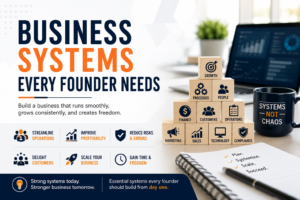
A business system is simply a repeatable process that helps your company operate consistently and efficiently. Instead of relying on memory, individual employees, or the founder’s constant involvement, systems ensure that tasks are completed the same way every time. Businesses with strong systems can scale faster, reduce errors, improve customer satisfaction, and continue operating smoothly even when the founder isn’t present.
If you’re serious about building a business rather than creating another full-time job for yourself, these are the essential business systems every founder should implement.
Customer Relationship Management (CRM) System
Your customers are the heart of your business, and managing those relationships effectively is crucial. A Customer Relationship Management (CRM) system helps you organize customer information, track conversations, monitor follow-ups, and manage sales opportunities in one place.
Without a CRM, valuable leads can easily be forgotten, follow-up calls may be missed, and customer communication becomes inconsistent. A well-managed CRM allows your team to understand every customer’s journey, resulting in better service, stronger relationships, and higher conversion rates. Whether you’re running a startup or an established business, a CRM is no longer optional—it’s an essential tool for growth.
Financial Management System
Revenue is important, but cash flow keeps a business alive. Many founders celebrate increasing sales without realizing their expenses are growing even faster. A financial management system gives you complete visibility into your business’s income, expenses, profits, taxes, and cash flow.
Regular financial reporting allows you to identify unnecessary spending, monitor profit margins, manage budgets, and make informed investment decisions. It also ensures that tax obligations, payroll, and vendor payments are handled on time. Businesses that review their financial performance regularly are far better prepared to navigate challenges and seize new opportunities.
Sales Management System
A successful sales process should never depend on luck. Every lead should move through a clearly defined journey—from initial inquiry to final purchase. A structured sales management system helps standardize this process and improves conversion rates.
Founders should establish clear sales stages, assign responsibilities, track follow-ups, and measure key performance indicators such as lead conversion rates and average sales cycle. By creating a repeatable sales process, businesses can forecast revenue more accurately and ensure that opportunities are never lost due to poor communication or inconsistent follow-up.
Marketing System
Marketing should generate measurable business results, not just online visibility. A structured marketing system enables businesses to consistently attract potential customers through multiple channels, including websites, search engines, social media, email marketing, and paid advertising.
Instead of launching random campaigns, successful businesses create marketing calendars, define target audiences, monitor campaign performance, and continuously optimize their strategies. Tracking website traffic, lead generation, customer acquisition costs, and conversion rates ensures that every marketing investment contributes to business growth.
Standard Operating Procedures (SOPs)
One of the biggest obstacles to business growth is inconsistency. When every employee performs tasks differently, service quality declines, mistakes increase, and training new team members becomes difficult.
Standard Operating Procedures (SOPs) provide step-by-step guidelines for performing routine business activities. Whether it’s onboarding a customer, processing an order, handling customer complaints, or managing inventory, documented procedures ensure consistency across the organization. SOPs reduce dependency on individuals and make it easier to scale operations without sacrificing quality.
Human Resource Management System
People are one of the most valuable assets in any organization. Hiring talented employees is only the first step; managing, developing, and retaining them is equally important.
An effective Human Resource Management system covers recruitment, employee onboarding, attendance, payroll, performance evaluations, training, and employee engagement. Clear job descriptions, regular performance reviews, and ongoing learning opportunities create a motivated workforce that contributes to long-term business success.
Project Management System
As businesses expand, managing multiple projects becomes increasingly challenging. Missed deadlines, unclear responsibilities, and poor communication can delay progress and affect customer satisfaction.
A project management system helps founders assign tasks, monitor project timelines, track milestones, and collaborate effectively with their teams. Whether launching a new product, implementing software, or executing a marketing campaign, organized project management ensures that work stays on schedule and objectives are achieved efficiently.
Inventory and Operations Management System
Businesses dealing with physical products need complete visibility over inventory and daily operations. Overstocking increases storage costs, while stock shortages lead to lost sales and dissatisfied customers.
An effective operations management system tracks inventory levels, supplier performance, procurement processes, production schedules, and order fulfillment. Automating these activities reduces manual errors, improves efficiency, and enables businesses to respond quickly to customer demand.
Customer Support System
Excellent products attract customers, but outstanding service keeps them coming back. A customer support system ensures that every customer inquiry, complaint, or service request is handled promptly and professionally.
Businesses should establish clear response times, maintain a centralized ticketing process, and regularly monitor customer satisfaction. Positive customer experiences lead to repeat purchases, referrals, and stronger brand loyalty. In today’s competitive market, customer service is often the factor that differentiates one business from another.
Compliance and Documentation System
Compliance is often overlooked until it becomes a problem. Missing statutory filings, expired licenses, incomplete documentation, or regulatory violations can result in financial penalties and legal complications.
Every business should have a system to manage registrations, tax filings, contracts, licenses, intellectual property, employee records, and other essential documents. Keeping compliance activities organized protects the business, builds credibility, and ensures smooth operations during audits or funding opportunities.
Business Performance Dashboard
You cannot improve what you don’t measure. A business performance dashboard brings together the most important metrics into one place, allowing founders to monitor business performance at a glance.
Instead of relying on assumptions, business owners should regularly review sales growth, profit margins, cash flow, customer acquisition, employee productivity, customer retention, and marketing performance. Monitoring these key indicators helps identify challenges early and supports better decision-making.
Why Systems Matter More Than Hard Work
Many founders believe that working longer hours will solve every business problem. In reality, growth comes from building systems that allow the business to operate efficiently without depending entirely on the founder. Businesses built on documented processes are easier to manage, easier to scale, and more attractive to investors, partners, and potential buyers.
The goal of entrepreneurship is not to become the busiest person in the company—it is to build an organization that can deliver consistent results, regardless of who is managing day-to-day activities.
Every successful company, regardless of its size, relies on well-designed business systems. These systems create consistency, improve productivity, reduce operational risks, and provide the structure needed for sustainable growth. While implementing systems requires time and effort initially, the long-term benefits far outweigh the investment.
As a founder, your role should gradually shift from managing daily tasks to leading the business strategically. The right systems allow your team to perform confidently, your customers to receive consistent service, and your business to grow without constant firefighting.
If your business still depends on you for every decision, every approval, and every process, it may be time to stop working harder and start building better systems. That’s how businesses become scalable, profitable, and ready for long-term success.